










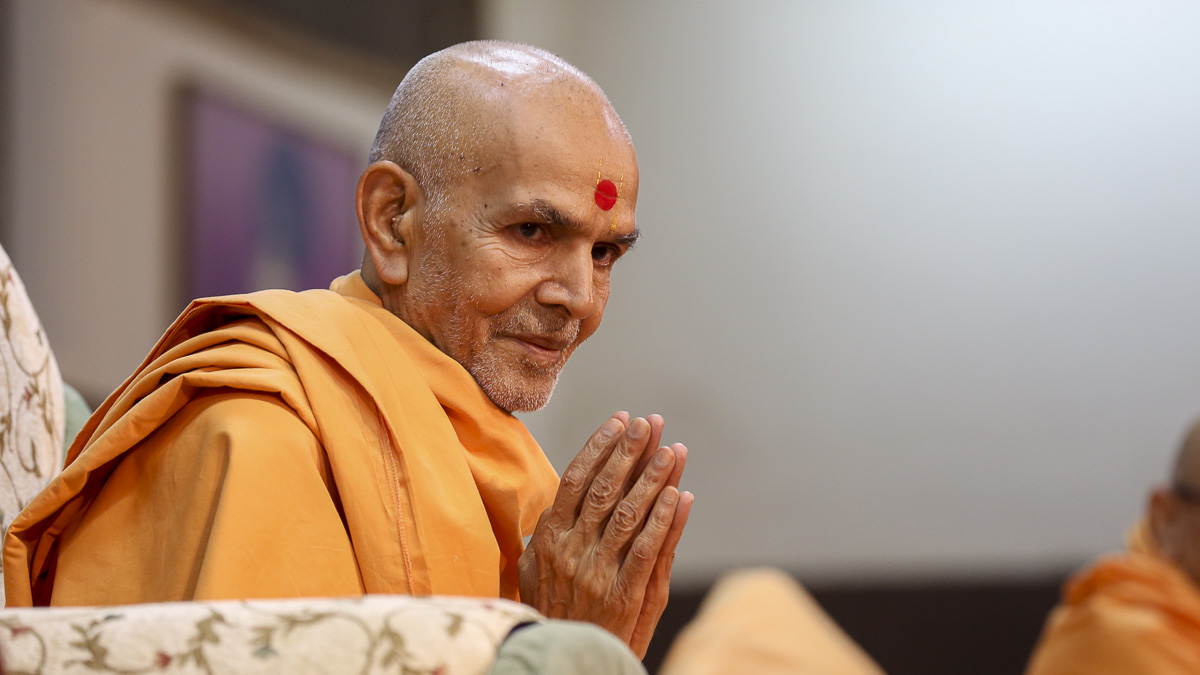
In 1975, in the quiet village of Javaraj, Gujarat, a tragic accident unfolded—sudden, painful, and unsettling. Several individuals were injured. Among them was Mahant Swami Maharaj. He had suffered a severe jaw injury, one that caused intense pain and required immediate medical attention.
Yet, what followed was not a story about physical suffering. It was a revelation of spiritual depth.
Pain That Revealed Compassion
Concern Beyond the Self
As doctors rushed to the scene, the natural expectation was clear: the most seriously injured would be treated first. But Mahant Swami Maharaj’s response defied instinct.
Despite his condition, he remained calm—his face peaceful, his heart attentive. His first words were not about his own pain, but about others.
“Please treat them first.”
Those words stunned everyone present.
Dr. Deepak, the physician who treated him, later recalled how extraordinary this moment was. Anyone else in such pain would have cried out, demanded relief, or shown distress. Swamishri did none of that. His awareness moved outward, not inward.
Selflessness in Action
Choosing Others Over Himself
The doctors insisted. His injury was severe. He needed urgent care. Yet Swamishri continued to express concern for those who were less injured than he was.
This was not forced humility.
This was not denial of pain.
It was empathy in its purest form—the instinct to place others before oneself, even when the body is hurting.
True compassion does not wait for comfort.
Atmabuddhi: Seeing Oneself in Others
A Profound Insight, Years Later
Years after the incident, when asked about that moment, Mahant Swami Maharaj shared a simple yet deeply transformative insight:
“When you are in pain, it helps you understand the pain of others.”
In that one sentence lies the essence of Atmabuddhi—seeing oneself in others.
Pain, in his vision, was not an obstacle. It was a teacher. It expanded the heart rather than closing it. Instead of turning inward in suffering, he turned outward in understanding.
Redefining Leadership and Compassion
Strength That Softens the Heart
In the world, leadership is often associated with authority, control, or being served. Saints redefine it.
Mahant Swami Maharaj showed that true leadership is the ability to feel another’s pain as your own. It is the courage to remain selfless even when one has every reason to focus on oneself.
To feel another’s suffering as your own is not weakness—it is spiritual strength.
This is compassion rooted in wisdom, not emotion alone.
A Lesson for Everyday Life
Small Acts, Lasting Impact
Most of us may never face such dramatic moments. But the principle applies daily.
- Choosing patience when we are tired
- Offering kindness when we are stressed
- Listening when we would rather speak
These are everyday expressions of Atmabuddhi.
Selflessness does not always appear heroic—often, it appears quietly.
Conclusion: Choosing Compassion in Moments of Pain
The incident in Javaraj is not remembered because of the accident, but because of the response to it.
Mahant Swami Maharaj turned pain into compassion, injury into insight, and suffering into service. His life reminds us that moments of difficulty are also moments of choice.
Will we retreat into ourselves?
Or will we let our pain open our hearts wider?
May this story inspire us to look beyond ourselves, to be sensitive to the struggles of others, and to embody the spirit of Atmabuddhi—in moments of comfort and especially in moments of pain.
Because sometimes, the deepest healing begins when we choose to care.
To know more about Mahant Swami Maharaj: https://www.baps.org/About-BAPS/TheFounder%E2%80%93BhagwanSwaminarayan/TheSpiritualLineage-TheGuruParampara/Mahant-Swami-Maharaj.aspx
Mahant Swami Maharaj: An Introductory Film on the Spiritual Leader of BAPS Swaminarayan Sanstha: https://www.youtube.com/watch?v=7s1OeBc3lHw&t=9s
BAPS Website: https://www.baps.org/

+ There are no comments
Add yours